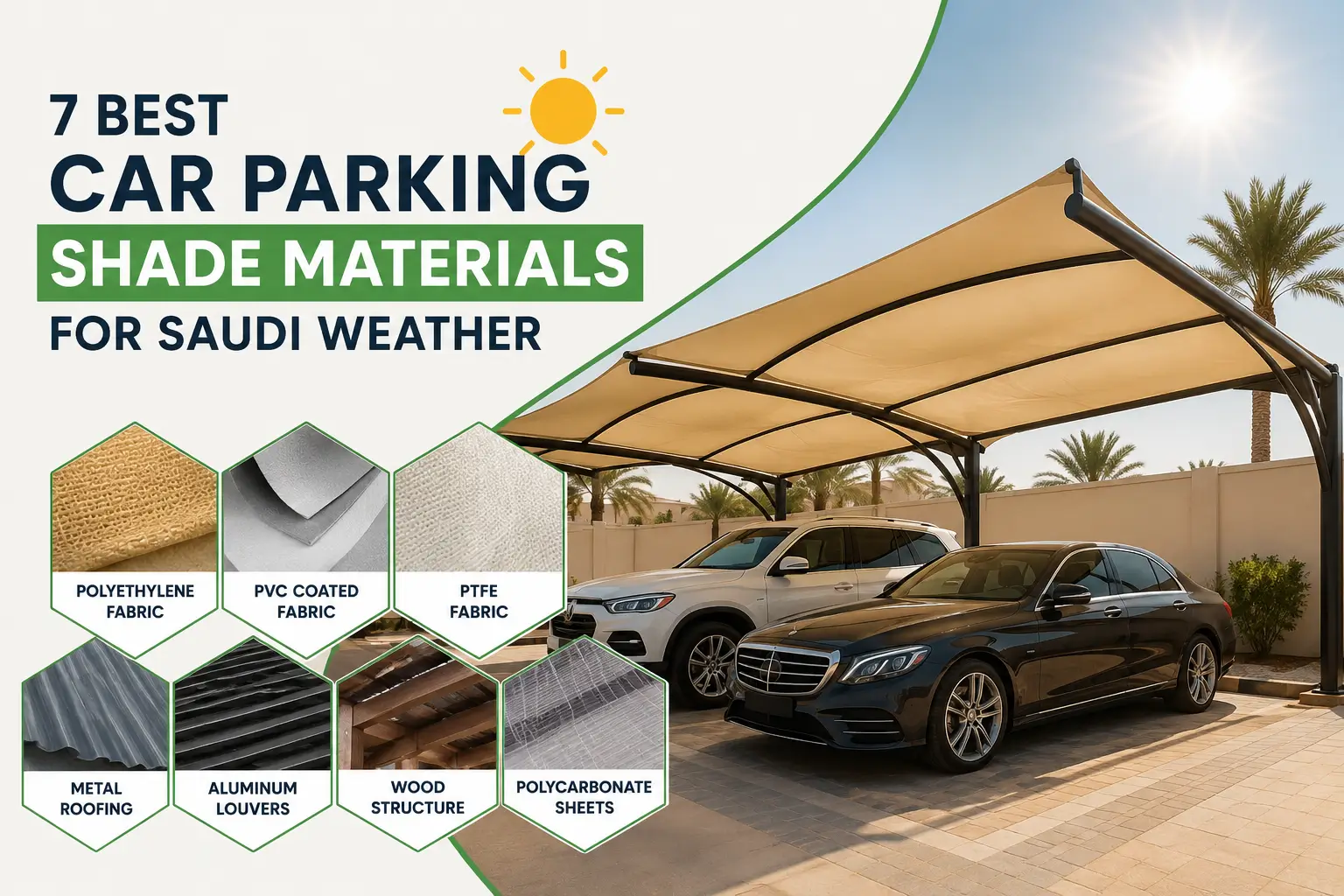
The 7 best car parking shade materials for Saudi weather are HDPE shade net, PVC coated polyester, PTFE membrane, polycarbonate sheet, ETFE film, galvanized steel framing, and powder coated aluminum framing. Each material resists 45°C summer heat, peak UV radiation, shamal sandstorms, and Gulf coast humidity at a different lifespan and price point.
The comparison below ranks all 7 fabric and frame options, explains how Saudi climate forces degrade each shading material, tabulates lifespan and cost data side by side, and lists the purchase checks that separate a 20 year canopy from a 5 year replacement cycle.
Key takeaways
- HDPE shade net blocks 90 to 98% of UV radiation and stays in service 8 to 12 years at 320 GSM.
- PVC coated polyester is 100% waterproof and lasts 12 to 20 years in Saudi conditions.
- PTFE membrane lasts more than 25 years and carries the highest cost per square meter.
- Polycarbonate sheet lasts 15 to 25 years and suits solid roof parking canopies.
- Galvanized steel framing supports every fabric option and withstands 150 km/h shamal wind loads.
Which 7 materials make the best car parking shades in Saudi Arabia?
The 7 best car parking shade materials in Saudi Arabia are listed below:
- HDPE shade net: knitted polyethylene mesh with 90 to 98% UV block and an 8 to 12 year lifespan.
- PVC coated polyester: waterproof tensile fabric with 100% UV block and a 12 to 20 year lifespan.
- PTFE membrane: fiberglass base fabric with a self-cleaning surface and a 25+ year lifespan.
- Polycarbonate sheet: rigid translucent panel with a 15 to 25 year lifespan.
- ETFE film: transparent architectural foil with a 20+ year lifespan.
- Galvanized steel framing: zinc coated structural skeleton for every fabric type.
- Powder coated aluminum framing: corrosion resistant frame option for coastal cities.
We have installed all seven across Saudi Arabia in 26 years of shade work, from villa driveways in Riyadh to the VIP parking bays we built for Aramco in Jazan. The fabric gets the attention, but the frame under it decides whether the structure survives its first proper shamal. Most of our replacement calls trace back to a cheap frame, not a torn fabric.
1. HDPE shade net
HDPE shade net is a knitted high-density polyethylene mesh that blocks 90 to 98% of UV radiation while letting hot air escape through its pores. The knitted structure of HDPE explains its dominance in Saudi car parks.
The mesh breathes. Hot air rising off a car bonnet passes straight through the weave instead of pooling under the canopy, which is why a Riyadh car park under 320 GSM HDPE runs noticeably cooler in August than the same layout under a solid roof. It will not stop rain, though, and that is the trade-off buyers accept: excellent heat control, zero waterproofing, and the lowest fabric price of the four.
2. PVC coated polyester
PVC coated polyester is a 100% waterproof tensile membrane, and is very durable in the Saudi sun, with a service life of 12 to 20 years. If the PVC is of good quality, a dust-free topcoat with a lacquer will prevent dust from adhering to the surface, and can be restored to a color with a hose rinse.
Waterproofing is the reason clients in Jeddah and Dammam pick it. When November rain arrives, cars under PVC stay dry while cars under mesh get a mud film from wet dust. The fabric weighs more than HDPE and traps more heat beneath it, so we pair it with an open-sided frame that lets crosswind clear the hot air.
3. PTFE membrane
PTFE membrane is a Teflon coated fiberglass fabric with a service life above 25 years. Airports and stadiums across the Gulf specify PTFE because rain rinses its non-stick surface clean without manual washing.
The price is the barrier. Expect roughly 4 to 6 times the cost of PVC per square meter, plus a stiffer fabric that demands precise tensioning during installation. For a government facility or a 200 bay commercial car park where the owner wants one canopy for 25 years, that math works. On a two car villa driveway, it rarely does.
4. Polycarbonate sheet
Polycarbonate sheet is a rigid UV coated panel that lasts 15 to 25 years and passes filtered daylight onto the parking bay. The panel takes hail, falling debris, and sandstorm abrasion better than any fabric.
Solid roofing changes the heat behavior. Without a ventilation gap along the ridge, trapped air under polycarbonate can push bay temperatures above what an open mesh canopy allows, so the frame design matters as much as the panel grade. We cut a 150 mm vent gap into most polycarbonate carports for exactly that reason.
5. ETFE film
ETFE film is a transparent fluoropolymer foil that lasts more than 20 years at roughly 1% of the weight of glass. Architects specify ETFE for cushion style canopies over showroom forecourts and mall entrances rather than standard car parks.
Weight is its main advantage. A lighter roof allows slimmer steel underneath, which cuts frame cost on wide spans. The foil transmits full daylight, so heat gain under it is real, and the specialist welding it needs keeps ETFE out of most residential quotes in Saudi Arabia.
6. Galvanized steel framing
Galvanized steel framing is a zinc coated structural skeleton that carries every shade fabric and withstands 150 km/h shamal wind loads. Hot dip galvanizing protects the steel for 20 to 25 years before the zinc layer wears through.
The frame decides the lifespan of the whole structure. A 25 year PTFE fabric on a rusting frame is a 5 year structure, and weld points rust first because site welding burns off the zinc. We spray cold galvanizing compound on every weld before paint at our Dammam workshop, and that single step separates our older installs from the ones we get called to replace.
7. Powder coated aluminum framing
Powder coated aluminum framing is a corrosion resistant frame option that suits coastal Saudi cities including Dammam, Jubail, and Jeddah. Aluminum does not rust in salt air the way untreated steel does.
Strength is the trade-off. Aluminum carries less load than steel at the same section size, so spans stay shorter or members grow thicker, and the material costs more per kilogram. On beachfront villas and marina car parks the corrosion resistance justifies that cost; 10 kilometers inland, galvanized steel usually wins on price.
How does Saudi weather break down car parking shade materials?
Saudi weather breaks down car parking shade materials through 4 forces: UV radiation, sustained heat above 45°C, shamal sandstorms, and coastal humidity. Each force attacks a different weak point in the fabric or frame.
UV does the slow damage. Summer sun in the interior bleaches cheap fabric within two seasons and turns unstabilized plastic brittle, which is why UV stabilizer content matters more than color when you compare quotes. Heat comes next; a dark fabric surface in Riyadh can pass 70°C at midday, and adhesives or low grade coatings soften long before the fibers fail.
Sandstorms work faster. A single spring shamal sandblasts a soft coating, and wind gusts load the frame anchors far beyond their everyday duty. Coastal humidity is the quiet one: our Dammam workshop sits close enough to the Gulf that we see uncoated steel brackets rust through in 3 to 4 years, while hot dip galvanized frames from the same era still hold. If your site is within a few kilometers of the coast, spend the extra riyals on the frame coating first and the fabric second.
Which car parking shade material lasts longest in Saudi weather?
PTFE membrane lasts longest in Saudi weather at more than 25 years, followed by polycarbonate sheet at 15 to 25 years, PVC coated polyester at 12 to 20 years, and HDPE shade net at 8 to 12 years. The table below compares the 4 main shade fabrics and panels on lifespan, UV block, waterproofing, and relative cost:
| Material | Lifespan in KSA | UV block | Waterproof | Relative cost |
| HDPE shade net | 8 to 12 years | 90 to 98% | No | Lowest |
| PVC coated polyester | 12 to 20 years | 100% | Yes | Medium |
| Polycarbonate sheet | 15 to 25 years | 100% with UV coat | Yes | High |
| PTFE membrane | 25+ years | 100% | Yes | Highest |
The table rewards a second look at cost per year rather than cost per install. PVC at a mid range price over 15 years often beats cheap HDPE replaced twice in the same period, and that is before counting the second installation crew. Lifespan figures assume correct tensioning; a slack fabric flaps in wind and can lose a third of its rated life.
What should you check before choosing a shade material in Saudi Arabia?
There are 5 checks to complete before choosing a shade material in Saudi Arabia: GSM rating, UV warranty, frame coating, wind load certification, and installer track record. The checks are listed below:
- Confirm the GSM rating on the fabric datasheet, with 320 GSM as the floor for HDPE car park use.
- Read the UV warranty terms, since 5 and 10 year fabric warranties differ in what fading they cover.
- Verify hot dip galvanizing or powder coating on every steel member, welds included.
- Request wind load calculations matched to your city, because Eastern Province gust ratings exceed inland ones.
- Inspect the installer’s completed sites older than 5 years, not the fresh ones.
Numbers on a datasheet only hold if the structure goes up correctly, and tensioning is where most cut rate crews fail. Our guide to car parking shade installation walks through footing depth, post anchoring, and fabric tensioning step by step, so you will know what a correct build looks like before signing anything.
FAQs
Is PVC better than HDPE for coastal Saudi cities?
Yes, PVC performs better than HDPE in coastal Saudi cities because PVC sheds rain, blocks salt spray, and resists humidity driven mold growth on the fabric surface. Salt air still reaches the frame either way, so the coating check above applies double on the coast.
Inland, the answer flips for many buyers; The airflow of HDPE wins in dry heat where rain barely features. We broke the full decision down city by city in our PVC vs HDPE parking shades comparison, including the GSM grades we quote for each.
Does polycarbonate outlast fabric shade materials?
Yes, polycarbonate outlasts most fabric shade materials, with a 15 to 25 year lifespan against 8 to 20 years for HDPE and PVC fabrics. The panel resists impact damage that would tear a membrane outright.
Fabric keeps two advantages: lower cost and lighter frames. A polycarbonate roof needs stronger purlins, so part of its price gap sits in steel rather than plastic. Our polycarbonate vs fabric parking shades comparison covers the frame math and the heat gap measurements in detail.
Can one shade material suit every Saudi city?
No, one shade material does not suit every Saudi city because coastal humidity, interior heat, and northern wind loads each demand different fabrics and coatings. Dammam favors waterproof PVC on aluminum or galvanized frames, Riyadh favors breathable HDPE, and high altitude Abha adds rain and cold cycling that push buyers toward PVC or polycarbonate.
Baqar Shades matches the material to the city on every quote, and our car parking shades service covers all 13 regions from the Dammam workshop we have run since 2000. Send us your location and bay count, and we will recommend the car parking shade materials that fit your city’s Saudi weather profile, not a one size answer.