
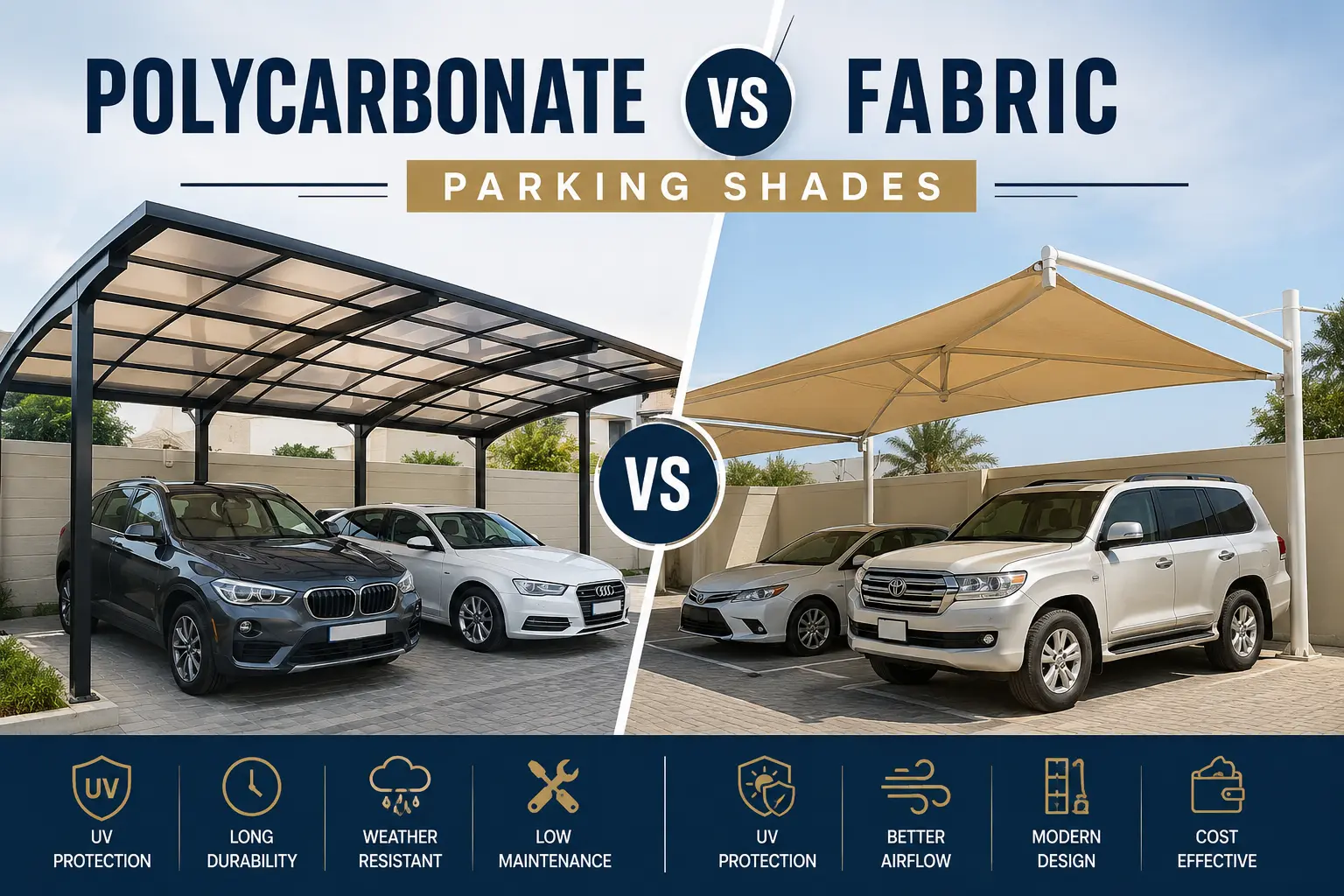
Polycarbonate lasts 15–25 years. Premium PVC fabric lasts 12–20 years. Standard HDPE lasts 8–12 years. That single fact changes every decision you make when choosing a car parking shade in Saudi Arabia.
Both materials protect vehicles from UV rays, extreme heat, and sandstorms, but they do it differently, at different price points, and with very different maintenance demands.
The right choice depends on whether you’re covering a residential villa driveway or a high-traffic commercial parking lot.
What Makes Polycarbonate Parking Shades Different From Fabric?
The fundamental difference comes down to rigidity vs breathability, two opposing design philosophies that suit different situations.
Polycarbonate- Rigid, Long-Lasting, and Light-Permitting
Polycarbonate is a thermoplastic polymer used in sheet form, the same material found in skylights and roofing. Mounted on metal frameworks, it creates a hard canopy that allows natural light through while blocking UV. Its rigid nature means zero sagging over time, a common frustration with stretched fabric.
Solid polycarbonate sheets offer impact resistance and transparency. Multiwall polycarbonate adds insulation properties and is more lightweight, useful for larger span installations. With proper UV stabilisers and coatings, panels resist yellowing and brittleness for up to 25 years.
Fabric Shades- Breathable, Flexible, and More Affordable
HDPE (High-Density Polyethylene) dominates 70–80% of residential and commercial installations across the region, for good reason. It’s breathable, allows airflow, and prevents the heat buildup that rigid materials can trap underneath.
PVC-coated fabric sits above HDPE on the performance ladder, 100% waterproof, with tensile strength of 3,500–5,500 N and color stability of 90%+ after 15 years. It’s the preferred material for premium residential and commercial applications.
Both fabric parking shade types have distinct GSM grades that determine how long they’ll last.
How Do Polycarbonate And Fabric Shades Compare Head-To-Head?
Understanding the numbers side by side makes the decision much clearer.
| Feature | Polycarbonate | PVC Fabric | HDPE Fabric |
| Lifespan | 15–25 years | 12–20 years | 8–12 years |
| UV Blockage | 95–99% | 98–99.5% | 95–98% |
| Waterproof | Yes | 100% | 90–95% repellent |
| Airflow | Low | Low | High |
| Sagging Risk | None | Low | Moderate |
| Cost | High | Medium-High | Low-Medium |
| Natural Light | Yes | No | No |
Polycarbonate vs PVC fabric for car shades, both are premium, but serve different priorities. Polycarbonate wins on natural light and rigidity; PVC wins on complete waterproofing and surface aesthetics.
Which Shade Material Suits Saudi Arabia’s Climate Best?
Saudi Arabia’s climate is genuinely one of the harshest environments any parking shade must survive, this isn’t generic advice territory.
Heat, UV, and Wind
Polycarbonate handles extreme heat without deforming, but poor-quality panels without UV coating yellow and become brittle faster than expected. Always insist on UV-stabilised grades.
HDPE at 300–320 GSM or above is the minimum standard for Saudi desert conditions. Budget grades at 180–220 GSM deteriorate in 3–4 years, a waste of money in this climate.
Both HDPE and PVC-coated fabric car parking shades handle winds up to 120 km/h when installed on proper galvanized steel frames with deep concrete anchoring.
Airflow Matters
In Dammam and Riyadh’s summer, temperatures under a solid shade can still climb uncomfortably. HDPE’s breathable weave, with shade density of 85–95%, allows air circulation that rigid polycarbonate and PVC cannot match.
For a residential villa carport where occupants walk past daily, that airflow difference is felt immediately.
Maintenance Differences Between Polycarbonate And Fabric Shades
Long-term ownership cost is rarely just the purchase price, maintenance habits shift that number significantly.
Routine Care for Each Material
Polycarbonate requires gentle cleaning with mild soap, never abrasive tools that scratch the surface coating. Inspect panels annually for early yellowing or hairline cracks, particularly at mounting points where stress concentrates.
HDPE fabric needs a tension check every 2–3 months, fabric naturally loses tightness over time and after storms. Clean with mild detergent, inspect worn edges, and schedule a post-storm inspection after any heavy sandstorm event.
At Baqar Shades, this maintenance briefing is part of every installation handover.
When to Repair vs Replace
PVC-coated fabric holds its coating integrity far longer than HDPE, less frequent replacement, but repairs are more technical if damage occurs.
Polycarbonate panels can be individually replaced without dismantling the entire frame structure, a practical advantage for commercial sites where downtime is costly.
Frequently Asked Questions
Which Lasts Longer, Polycarbonate or Fabric Car Shades?
Polycarbonate leads at 15–25 years. Premium PVC follows at 12–20 years. HDPE ranges from 8–12 years at premium GSM grades. For maximum lifespan with lowest long-term replacement cost, polycarbonate or high-grade PVC are the strongest choices.
Is Polycarbonate Better Than HDPE for Saudi Arabia’s Climate?
It depends on the priority. Polycarbonate suits situations where natural light, rigidity, and no-sag performance matter most. HDPE wins where airflow, budget, and quick installation are the priority. Both perform well when installed correctly on quality steel frames.
What Is the Cost Difference Between Polycarbonate and Fabric Shades?
PVC fabric costs 80–120% more than HDPE upfront. Polycarbonate typically exceeds both fabric types in initial investment, but its longer lifespan reduces replacement cycles, making it more cost-effective over 20+ years.
Can Fabric Shades Withstand Saudi Sandstorms?
Yes, 300+ GSM HDPE and PVC-coated fabric both handle winds up to 120 km/h when properly anchored. The critical factor is the galvanized steel frame and concrete footing depth, not the fabric grade alone.
Which Shade Material Is Best for a Villa in Dammam or Riyadh?
For luxury villas, PVC or polycarbonate delivers premium aesthetics with a long lifespan. For budget-conscious villa owners, 300+ GSM HDPE is the most practical, proven, and cost-effective parking shade material for Saudi residential use.