
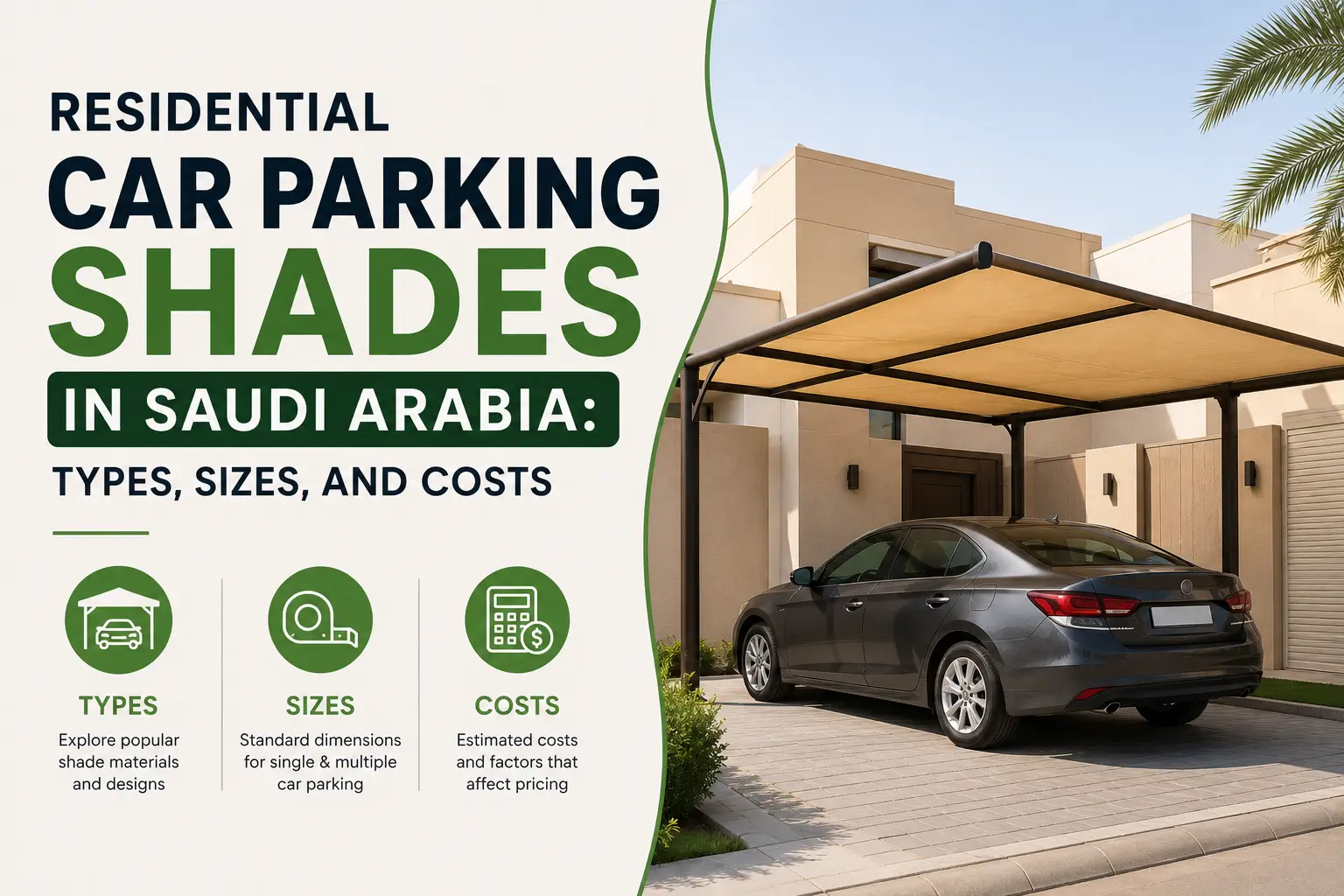
Residential car parking shades in Saudi Arabia are steel-framed fabric or panel structures installed at villas and homes to protect 1 to 4 vehicles from UV radiation and heat. Common home designs include cantilever, wall-mounted, pyramid, sail, and wooden pergola shades, with a single-car unit measuring 3 x 6 meters.
Picking one for a home is a different exercise from specifying a commercial lot, mostly because the constraints change. A villa owner works around a boundary wall, a gate position, maybe a palm tree the family refuses to move, and a municipality that has opinions about anything visible from the street. The good news is that the residential end of this market has settled into fairly standard designs and sizes, so the real decisions come down to shade type, fabric, and how much of the budget goes into the frame.
Key takeaways
- Residential car parking shades in Saudi Arabia protect 1 to 4 vehicles per structure at villas and homes.
- A single-car shade measures 3 x 6 meters; a double-car unit runs 5.5 x 6 meters.
- HDPE fabric suits open driveways; PVC suits owners who want full rain protection.
- Installed prices start near SAR 2,000 for a basic single-car HDPE shade.
- Street-facing shades at villas require municipality (baladiya) approval in most Saudi cities.
Types of residential car parking shades
The 5 common types of residential car parking shades in Saudi Arabia are listed below:
- Cantilever shades stand on posts along one side only, which keeps the parking bay clear for door swings and reversing.
- Wall-mounted shades fix directly to the villa’s boundary or house wall, saving space on narrow plots.
- Pyramid shades use a center or corner support with a peaked top, a shape that sheds dust and handles wind well.
- Sail shades stretch tensioned fabric between 3 or 4 anchor points for a lighter, more architectural look.
- Wooden pergola shades pair a timber or wood-finish frame with fabric or slats, usually chosen to match villa exteriors.
Cantilever ends up on most home driveways for a practical reason. Posts on one side mean nobody dents a door against a column at 7 in the morning, while the bay stays usable for a second car later. Wall-mounted designs win on tight plots where every half meter counts, though the wall itself has to be structural; a screen block fence won’t carry the load. Sail and pergola styles cost more per square meter and get picked mainly on looks. Nothing wrong with that; it’s the same fabric protecting the car either way.
Best material for a home car parking shade
HDPE knitted fabric is the best material for open residential driveways in Saudi Arabia, while PVC-coated polyester suits homes that need full rain and dust blockage.
The honest comparison runs like this. HDPE breathes, so heat escapes upward instead of cooking the car from above, and it costs less per meter. What it doesn’t do is stop rain, which matters maybe 15 days a year in Riyadh and rather more along the coast. That’s a real gap for some households and irrelevant for others. PVC is waterproof, heavier at 650 to 900 gsm, and reads as more premium, but a south-facing PVC cover with no airflow can sag early in the Saudi summer. Polycarbonate panels show up on villa carports where owners want daylight underneath; they don’t fade like fabric, though the fixing points tend to crack around year 10 to 12. Wood-look aluminum has been creeping into newer compounds too, mostly for appearance rather than performance.
Standard sizes for home car parking shades
The table below lists the standard residential car parking shade sizes used across Saudi Arabia:
| Configuration | Typical size | Clearance height |
| Single car | 3 x 6 m | 2.7 to 3 m |
| Double car | 5.5 x 6 m | 2.7 to 3 m |
| Triple car | 8 x 6 m | 3 m |
| SUV or 4×4 bay | 3.5 x 6.5 m | 3.2 m |
Sizing mistakes at homes almost always go the same direction: too tight. A shade that clears a sedan by half a meter looks fine until the family buys a Land Cruiser with roof rails. Adding half a meter of width and height at the design stage costs a few hundred riyals; retrofitting later doesn’t work that way, since a taller frame is a new frame. Depth matters less, since 6 meters covers nearly every private vehicle sold in the Kingdom with room to spare.
Residential car parking shade prices in Saudi Arabia
Residential car parking shade prices in Saudi Arabia range from SAR 2,000 to 4,500 for a single-car HDPE shade and SAR 4,000 to 8,000 for a PVC unit installed.
Per square meter, quotes across Saudi suppliers mostly land between SAR 90 and 160 for HDPE and SAR 160 to 300 for PVC, with wooden pergola structures running SAR 350 to 600. The spread inside each range isn’t random, and it’s mostly not about the fabric. Foundation work moves the number more than fabric choice does; a shade anchored into an existing concrete driveway costs noticeably less than one needing new footings dug through interlock paving. Steel gauge, powder coating, and gutter or drainage additions push quotes toward the top end. A double-car shade never costs double a single, either. Sharing a frame typically saves 15 to 20 percent per bay, which is why suppliers push the wider unit when the plot allows it.
What to check before installing a shade at a villa
Homeowners in Saudi Arabia check 4 things before installing a car parking shade: municipality approval, boundary setbacks, wind anchoring, and drainage direction.
The baladiya point trips up more people than any technical issue. Most Saudi municipalities require approval for shades visible from the street. A few compounds then add their own design rules on top, sometimes down to the fabric color. It’s cheaper to get the approval first than to argue after a removal notice. Boundary setbacks matter when the shade edge would overhang a neighbor’s wall; a signed no-objection from the neighbor usually settles it. Anchoring is the one to never economize on, since a home shade faces the same shamal winds a commercial one does, just with the family’s cars underneath. And drainage sounds trivial until the first proper rain sends a sheet of water off the shade straight at the front door.
Residential car parking shade suppliers in Saudi Arabia
The 5 known suppliers of residential car parking shades in Saudi Arabia are listed below:
- Baqar Shades installs residential car parking shades across Saudi Arabia from its Dammam base, with 26 years in the trade covering villa, compound, and commercial projects.
- Serene Shades fabricates parking, pergola, and sail shades for homes and businesses across the Kingdom.
- Mofeed Parking Shades supplies HDPE and PVC car shade canopies for residential and commercial sites.
- Al Jazeera International builds cantilever, arch, and cobra design shades for villas and offices.
- Car Parking Shade Dammam (CPSD) covers residential driveways and commercial lots in the Eastern Province.
A villa shade done properly is a one-afternoon decision followed by 15 quiet years, and done badly it’s a removal notice or a torn cover in the second summer. The difference sits in four early choices: the right size with headroom to spare, fabric matched to the site, anchoring that respects the wind, and the baladiya paperwork sorted before the first post goes in.
FAQs
What size shade fits two cars at a villa?
A double-car residential shade measures 5.5 x 6 meters with a clearance height of 2.7 to 3 meters. Villas parking an SUV alongside a sedan benefit from 6 meters of width.
Do home car parking shades need municipality approval in Saudi Arabia?
Yes, most Saudi municipalities require baladiya approval for shades visible from the street. Shades inside a walled compound courtyard often fall outside the requirement, though rules vary by city.
Which is cheaper for a home shade, HDPE or PVC?
HDPE is cheaper at SAR 90 to 160 per square meter installed, against SAR 160 to 300 for PVC. PVC adds full rain protection for the higher price.
How long does installation take at a house?
Residential car parking shade installation takes 2 to 5 days at a house, covering foundation work, frame erection, and fabric tensioning. Shades on existing concrete finish faster than those needing new footings.