
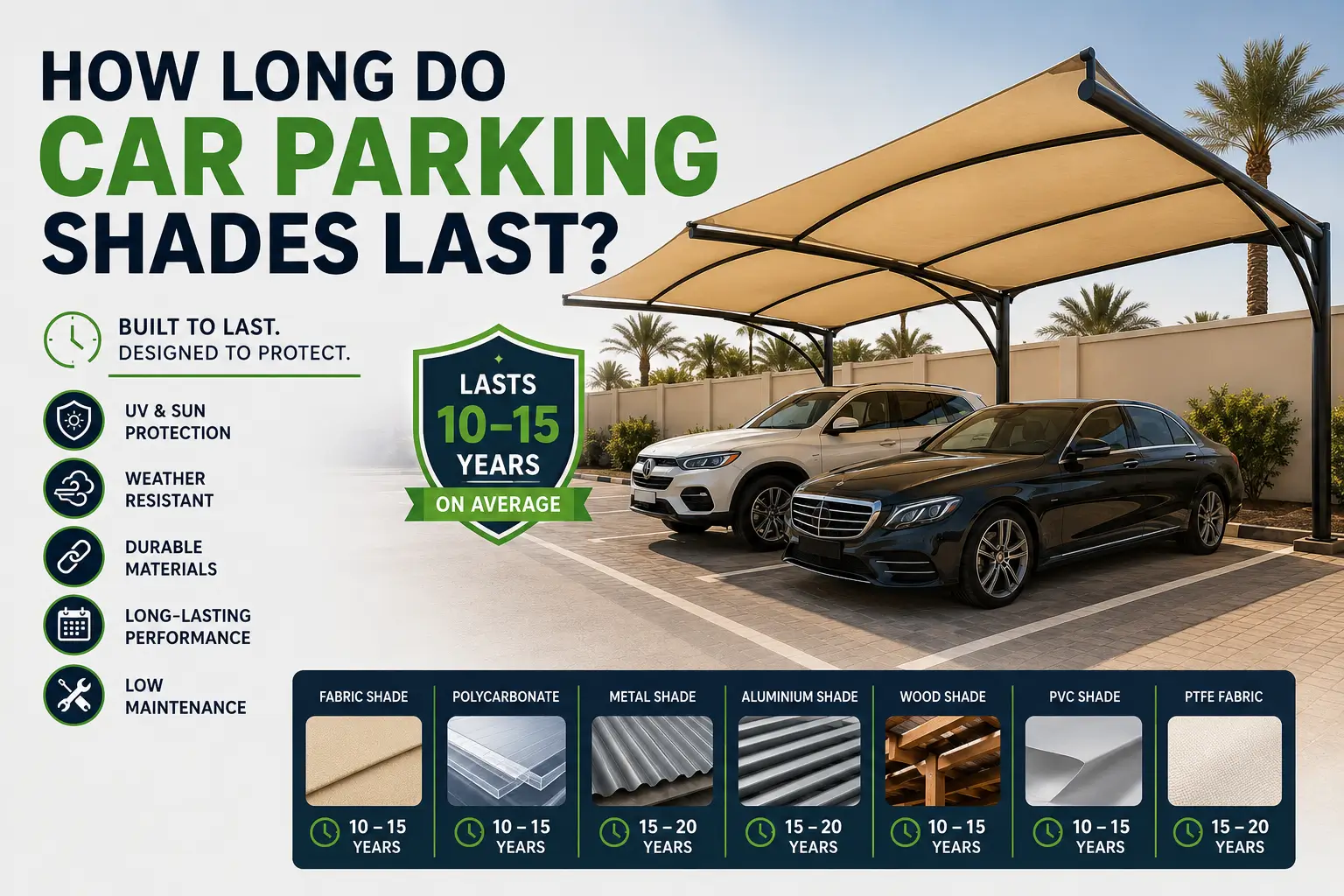
Car parking shades last 10 to 15 years on average. HDPE fabric shades hold 10 to 15 years, PVC-coated polyester lasts 10 to 20 years, polycarbonate panels reach 10 to 15 years, and galvanized steel frames exceed 20 years with basic maintenance.
Those numbers come from warranty documents rather than sales pages, which makes them worth something.
Saudi Arabia complicates the picture, though. A cover that would coast to year 15 somewhere mild might only see 10 or 11 in Riyadh, where the fabric surface can sit above 70 degrees Celsius through August and a sandstorm or two scrubs it every year.
Where a particular shade lands inside its range mostly comes down to three things: what it’s made of, how well it was installed, and a small amount of upkeep that most owners skip.
Key takeaways
- Car parking shades last 10 to 15 years on average across common materials.
- HDPE shade fabric carries 8 to 10 year UV warranties in most Gulf installations.
- Steel frames outlast fabric roughly 2 to 1; one frame typically wears through 2 fabric covers.
- Saudi summer heat, UV exposure, and sandstorms push fabric toward the lower end of its range.
- Re-tensioning the fabric every 2 to 3 years adds 3 to 5 years of usable life.
Average lifespan of a car parking shade
The average car parking shade lasts 12 years, with a realistic range of 10 to 15 years for fabric structures and 20 or more years for the steel frame beneath the fabric.
There’s a split inside that number which most buyers only discover around year 8, and it’s this: the frame and the cover don’t age at the same speed. Not even close. Galvanized or powder-coated steel barely changes over a decade. The fabric above it, meanwhile, fades, goes slack, and eventually tears. That’s the whole reason established suppliers quote fabric replacement as its own cheaper service instead of pushing a rebuild. So the sensible way to budget is one cover change per frame, somewhere in the middle of the structure’s life. Handled that way, a single frame keeps protecting cars for 20 to 25 years.
Car parking shade lifespan by material
The table below lists the expected lifespan of 5 common car parking shade materials in Gulf conditions:
| Material | Expected lifespan | Typical warranty |
| HDPE knitted fabric | 10 to 15 years | 8 to 10 years |
| PVC-coated polyester | 10 to 20 years | 10 years |
| Polycarbonate sheets | 10 to 15 years | 10 years |
| Sail shades (tensioned fabric) | 5 to 10 years | 5 years |
| Galvanized steel frame | 20 to 30 years | 10+ years |
HDPE stays the default for open-air parking. The reason is physical, not commercial. Its knitted weave lets hot air rise through the fabric instead of trapping it, so both the cover and the cars beneath it run cooler. PVC looks better on paper because it’s waterproof and much heavier, somewhere around 650 to 900 gsm against HDPE’s 320 to 340. That extra weight isn’t free, though. Facing south with poor airflow, PVC tends to sag and discolor well before its warranty says it should. Polycarbonate has a different failure mode altogether; the sheets don’t fade the way fabric does, but hairline cracks around the fixing points usually show up before year 12. Sail shades sit at the bottom of that table for the obvious reason, thinner fabric under higher tension doesn’t last.
What shortens the lifespan of car parking shades in Saudi Arabia
Four factors shorten car parking shade lifespan in Saudi Arabia: UV radiation, heat cycling, wind flutter, and sand abrasion.
UV is the slow one. Saudi Arabia records some of the highest solar irradiance on earth. That exposure keeps breaking down the polymer chains in the fabric until, years in, the material turns brittle. Heat cycling adds to it in a quieter way. A cover expands in 65-degree August heat, contracts on a 5-degree January night, and gives up a little tension with every cycle.
Wind works faster. A cover held at full tension sheds wind fine; a loose one flaps, and the flapping is what actually tears fabric rather than the wind load itself. Then sandstorms come through and grind the UV coating off the surface, which shortens whatever life was left. Anyone with a shade in Dammam or elsewhere in the Eastern Province gets a bonus problem on top, salt humidity that eats uncoated steel fixings long before the fabric shows any wear.
How to make a car parking shade last longer
Owners extend car parking shade lifespan through 4 maintenance actions: scheduled re-tensioning, annual washing, prompt small repairs, and fixing-point inspection.
None of it costs much. Re-tensioning every 2 to 3 years kills the flutter that wrecks covers early, and a crew normally gets it done in under a day. Washing gets ignored in Saudi cities more than it should; fine dust settles into the weave, holds heat against the fabric, and quietly speeds up the UV damage, so a fresh-water rinse once a year pays for itself. Small tears can’t be left for later either. A 5 cm nick at the edge turns into a half-meter rip after one windy weekend, which is the difference between a patch and a new panel. And once a year it’s worth looking at the fixing points, because rust at a single bracket will drop tension across the whole cover.
Signs a car parking shade needs replacement
A car parking shade needs replacement when the fabric shows widespread fading, brittleness, sagging that re-tensioning cannot fix, or tears longer than 30 cm along seams.
Fading on its own isn’t structural. What it does mean is that the UV protection has dropped, at which point the paint on the cars underneath starts paying the bill. Brittleness is the harder deadline. Pinch a corner of old fabric between two fingers; if it cracks instead of flexing, the polymer’s gone and no repair brings it back. At that stage a fabric-only replacement on the existing frame runs roughly 40 to 60 percent of a new structure, which is exactly why suppliers of car parking shades in Saudi Arabia treat re-covering as a routine service rather than a special order. Frames are a different story. Before year 20 they rarely need replacing at all, unless corrosion at the base plates went unnoticed for years.
Car parking shade suppliers in Saudi Arabia
The 5 known suppliers of car parking shades in Saudi Arabia are listed below:
- Baqar Shades supplies and installs car parking shades across Saudi Arabia from its Dammam base, with 26 years in the trade and projects delivered for Aramco facilities in Jazan and Abha.
- Serene Shades fabricates parking, pergola, and sail shades for residential and commercial sites across the Kingdom.
- Al Mawsim Tents produces parking shades and tent structures for residential and event use.
- YKM Group manufactures shade structures and tensile systems for large commercial parking areas.
- Shade Systems covers Jeddah and surrounding suburbs with HDPE sail and parking shade installations.
Fifteen years out of one shade isn’t luck so much as three decisions made early: fabric rated for Gulf UV levels, a frame anchored in proper concrete footings, and re-tensioning done on schedule instead of after the first tear. Owners who get those right tend to find the 10 to 15 year average sits closer to a starting point than a ceiling.
FAQs:
How often do car parking shade fabrics need replacing?
Car parking shade fabric needs replacing every 10 to 15 years in Gulf conditions. Owners who skip re-tensioning and washing often replace fabric closer to year 8.
Which car parking shade material lasts the longest?
PVC-coated polyester lasts the longest among fabric options at 10 to 20 years, while galvanized steel frames outlast every cover at 20 to 30 years. HDPE remains the better pick for ventilation in open parking.
Do car parking shades survive strong winds?
Yes, engineered car parking shades withstand wind speeds of 100 to 120 km/h when the frame is anchored in concrete footings and the fabric is kept at full tension. Loose fabric fails at far lower speeds.
Does the Saudi climate reduce shade lifespan?
Yes, high UV levels, 45 to 50 degree summers, and sandstorms reduce shade fabric lifespan by 20 to 30 percent compared with mild climates. Frames remain largely unaffected.