
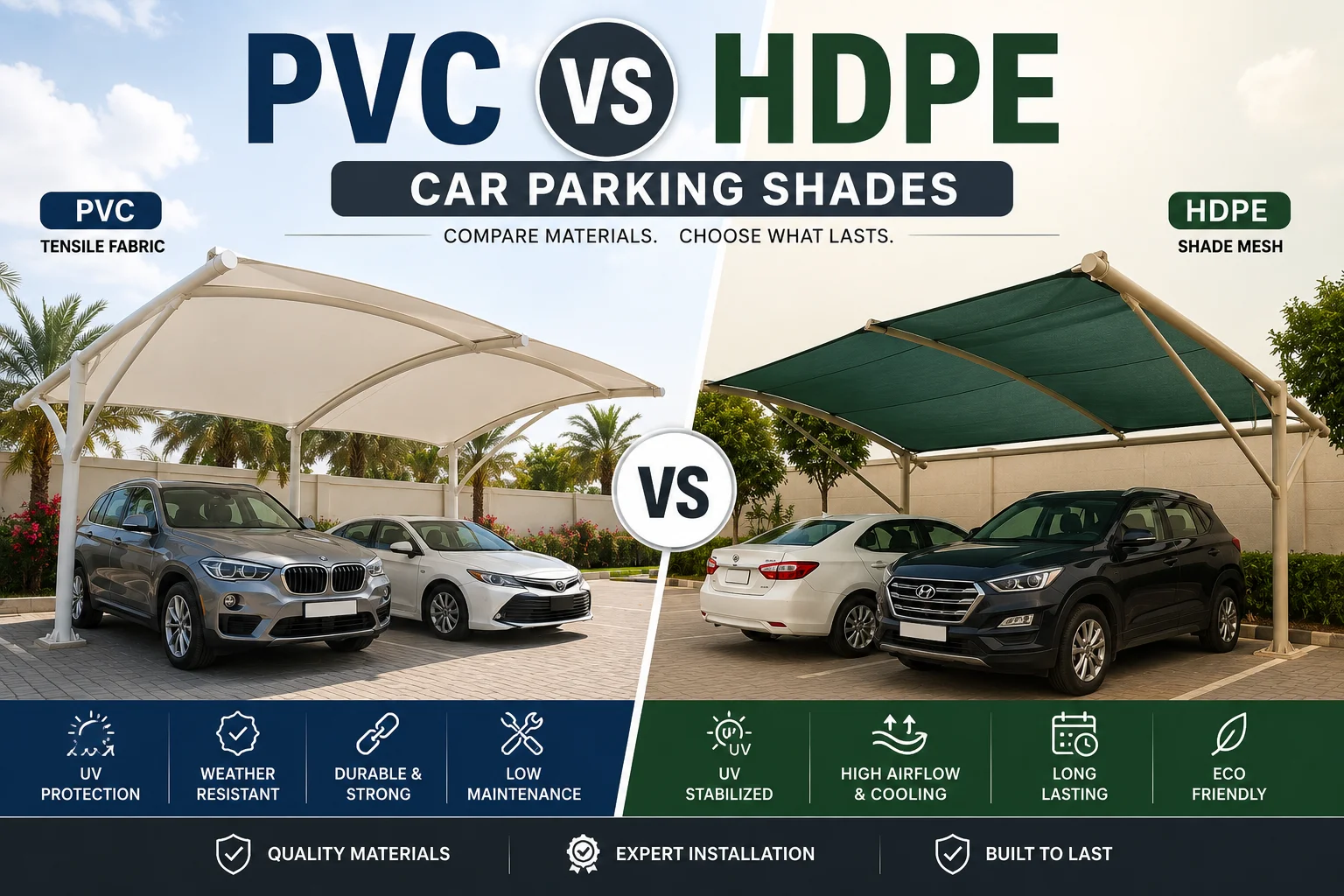
PVC lasts 12-20 years and is 100% waterproof. HDPE lasts 8-12 years at premium GSM and keeps air moving under the canopy. That single trade-off defines the entire PVC vs HDPE car parking shade decision for Saudi Arabia.
Both materials protect vehicles from UV radiation, heat, dust, and seasonal rain, but they do it through completely different engineering. Your choice comes down to one question: do you need complete waterproofing or do you need airflow?
What Makes PVC And HDPE Structurally Different?
Most buyers treat this as a cost decision. It isn’t, it’s a performance decision with cost consequences.
How PVC Fabric Is Built
PVC is a synthetic plastic polymer built in a multilayer structure, a mesh base sandwiched between two PVC coating layers. That construction is what delivers 100% waterproofing and 3,500-5,500 N tensile strength. The fabric resists tears and punctures more aggressively than any woven shade net.
GSM grades range from 650-750 (light) up to 1,200-1,400 (architectural). Higher GSM means heavier fabric, which demands robust structural support from the steel frame. Color stability stays above 90% even after 15 years in direct sun, and the PVDF self-cleaning coating option reduces maintenance significantly.
How HDPE Fabric Is Built
HDPE (woven polyethylene) integrates UV-stabilizing additives directly during manufacturing, not applied as a surface coating. That’s why it resists moisture, chemicals, and insects more consistently over time.
The woven structure is what separates it from PVC. It allows airflow, prevents heat buildup under the canopy, and reduces interior car temperature by up to 15°C, a meaningful number in a Saudi summer. It handles temperatures up to 120°C and wind resistance up to 120 km/h when properly installed.
A Quick Glimpse On PVC Vs HDPE Car Parking Shades
Numbers clarify what marketing language obscures.
| Feature | PVC | HDPE (300+ GSM) |
| Waterproofing | 100% | 90-95% repellent |
| Lifespan | 12-20 years | 8-12 years |
| Tensile Strength | 3,500-5,500 N | 2,200-3,000 N |
| Airflow | Low | High |
| Cost | Higher | Lower |
| Weight | Heavier | Lightweight |
| Fire Rating | Class A/B | Flame retardant |
| Maintenance | Low | Low-Moderate |
PVC vs HDPE parking shade fabric, PVC wins on waterproofing and longevity; HDPE wins on airflow, weight, and upfront cost. Neither is universally superior, context decides.
Which Applications Suit PVC And Which Suit HDPE?
The mistake most buyers make is choosing a material without matching it to the actual use case.
Where PVC Performs Best
Luxury villas, hotels, malls, and airports all benefit from PVC’s premium aesthetics and full waterproofing. In areas with seasonal rain, particularly Jeddah, PVC’s glossy finish and complete water barrier justify its higher cost.
Commercial high-traffic parking with brand visibility requirements also suits PVC, it takes custom colors and opacities cleanly, and its smooth surface maintains appearance under heavy use longer than woven HDPE.
Where HDPE Is the Smarter Choice
Residential villa parking, compound areas, schools, and mosques all benefit more from HDPE’s ventilation than from PVC’s waterproofing. In high-temperature exposed parking, airflow genuinely reduces discomfort for vehicle occupants returning to their cars.
Budget-conscious HDPE parking shade buyers should avoid anything below 300 GSM for Saudi conditions, 180-220 GSM grades degrade in 3-4 years, making them a false economy. At Baqar Shades, the minimum recommended grade for any Saudi installation is 300 GSM.
What Are The Size, Structure, And Color Options For Each Material?
Both materials work across the same structural systems, the frame doesn’t change, the fabric does.
Standard Sizes and Structures
Standard sizes run 6.0m x 3.0m (single car) and 6.0m x 6.0m (two cars), with a standard 2.5m open height, all modifiable on request. Structural options include pyramid, cantilever, dome, sail, and wing, all available in both PVC and HDPE.
HDPE color range covers white, cream, green, dark green, dark grey, grey, orange, yellow, black, red, blue, and dark blue. HDPE shades can also be customized with a logo, name, or slogan, useful for commercial and institutional applications.
Maintenance Differences Worth Knowing
PVC needs only periodic cleaning with mild detergent, inspect coating integrity annually. It requires no retensioning and no painting.
HDPE needs a tension check every 2-3 months, a post-storm inspection after heavy sandstorms, and worn edge replacement as needed. Neither material requires painting or coating, but HDPE demands more active monitoring to catch early fabric loosening before it stresses the frame. For certified installation and ongoing support across Saudi Arabia, Baqar Shades handles both materials.
Final Thoughts
Choosing between PVC and HDPE ultimately comes down to what your parking space actually demands, not just what looks good on paper. If complete waterproofing and a premium finish matter most, PVC is the stronger long-term investment. If airflow, affordability, and faster installation are the priority, 300+ GSM HDPE delivers reliable performance through Saudi Arabia’s harshest conditions. Either way, the material is only as good as the installation behind it, so choosing a certified installer matters just as much as choosing the right fabric.
Frequently Asked Questions
Which Is Better for Saudi Arabia’s Climate, PVC or HDPE?
Both perform well. PVC suits full waterproofing and premium aesthetics. HDPE is better where cabin heat reduction and airflow matter. For most residential applications, 300+ GSM HDPE is the practical and cost-effective choice.
How Long Does PVC Last Compared to HDPE?
Premium PVC lasts 12-20 years. 300-350 GSM HDPE lasts 8-12 years. Budget HDPE at 180-220 GSM degrades in just 3-4 years under Saudi desert conditions, avoid it.
Is PVC More Expensive Than HDPE?
Yes, PVC costs 80-120% more than HDPE upfront. However, its longer lifespan and waterproofing capability lower long-term replacement costs for premium installations.
Can HDPE Withstand Saudi Sandstorms?
Yes, 300+ GSM HDPE handles winds up to 120 km/h. Proper installation on galvanized steel frames with deep concrete footings is what actually determines storm resistance.
Which Material Is Best for a Villa in Jeddah or Riyadh?
PVC for a luxury villa requiring premium appearance and complete waterproofing. 300+ GSM HDPE for a budget-conscious villa owner prioritizing ventilation and affordability, the most practical HDPE car parking shade for Saudi villas available.